Why We Invested in Shelfmark: Giving Production Lines a Memory

Shelfmark is helping continuous-flow manufacturers catch defects, uncover their causes, and prevent them from happening again.
C2 Ventures is pleased to announce our investment as part of the second close of Shelfmark’s $3.5 million seed financing, led by Armory Square Ventures.
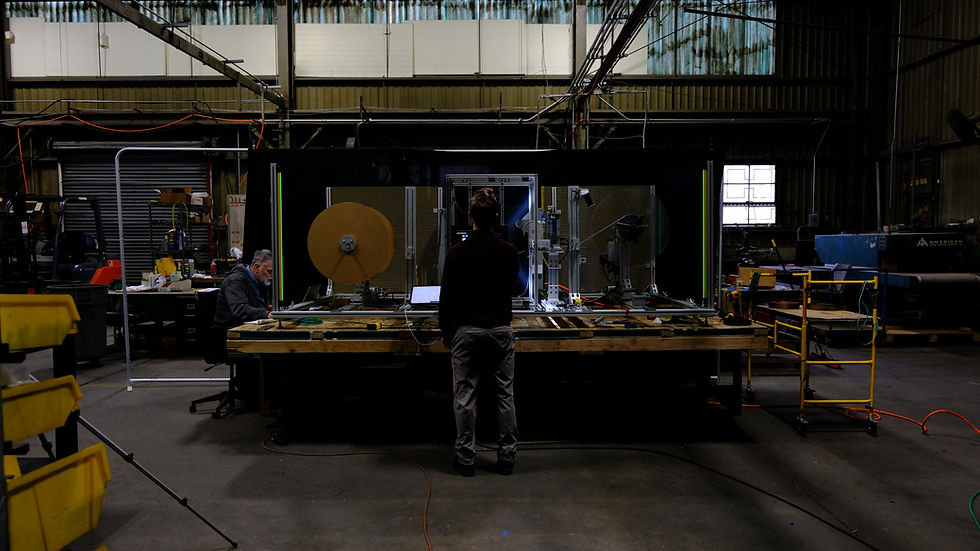
Shelfmark is an AI-native production intelligence platform built for continuous-flow manufacturing, where industrial films, labels, textiles, coatings, and other essential materials can move through production lines at hundreds of feet per minute.
This is exactly the type of industrial AI application we find compelling: a large, durable market underserved by modern software; a repetitive task that is difficult for people to perform consistently; and a technology capable of producing tangible operational returns.
A difficult job with expensive consequences
Quality inspection on continuous-flow production lines remains an incredibly manual process.
Workers are often tasked with monitoring material as it moves continuously in front of them, looking for defects that may be smaller than a human hair. Maintaining that level of focus and precision across an entire shift is nearly impossible.
When a defect is missed, the impact can extend well beyond the material itself. Manufacturers face wasted inventory, rework, line stoppages, downgraded products, rejected shipments, and unhappy customers.
Traditional machine-vision systems have attempted to address this problem, but they can be expensive, rigid, and difficult to adapt across different materials, products, and operating environments.
Shelfmark has developed a more flexible approach.
From detecting defects to understanding their causes
Shelfmark combines deep-learning computer vision, specialized line-scan cameras, and production data to inspect 100% of material as it moves through the line.
The platform identifies defects in real time, alerts operators, and creates a digital record of what happened during each production run. Shelfmark reports inspection accuracy of up to 99.5%, including on materials previously considered too fast, reflective or variable to inspect reliably with automation.
Catching the defect is only the first step.
Shelfmark connects defects with the production conditions surrounding them, including temperature, humidity, pressure, and line speed. This helps manufacturers understand what went wrong, identify patterns across multiple runs, and determine how to prevent the same problem from returning.
Instead of treating every defect as an isolated incident, manufacturers begin building an operational memory of the line.
Tangible results on the factory floor
Industrial technology has to produce measurable value under real operating conditions. Technical novelty alone will not carry a product beyond the pilot stage.
Shelfmark reports that it has worked with more than 40 manufacturing facilities and converted nine out of ten pilots into customers.
Across its deployments, customers have reported:
Waste reductions of up to 90%
Inspection labor reductions of 50%
Inspection accuracy of up to 99.5%
Returns of up to seven times the investment
The value is direct: less scrap, less manual inspection, fewer production interruptions, and more usable output from the same equipment and workforce.
Shelfmark also manages the complete system, including cameras, edge hardware, software, and machine-learning models. Manufacturers gain the benefits of production intelligence without having to build and maintain an internal machine-vision operation.
The larger opportunity
The immediate value proposition is clear, but the longer-term opportunity is even more compelling.
Every production run creates a digital record of what happened on the line. Over time, that gives manufacturers a growing dataset they can use to identify patterns, improve processes and make better operating decisions.
This creates a path from defect detection to root-cause analysis, predictive recommendations, and, ultimately, production lines capable of adjusting before problems occur.
Shelfmark has the potential to become the persistent intelligence layer across continuous-flow manufacturing: a system that helps production lines see every inch, understand what happened, and improve with every run.

Why C2 Ventures invested in Shelfmark
C2 Ventures has spent years investing in AI-supported software, robotics, and automation for legacy industries. We look for companies that apply technology to expensive operational problems in markets where the status quo has been accepted for too long.
Shelfmark fits that thesis on several levels.
Continuous-flow manufacturing is a massive and fragmented market that has historically received less attention from modern software providers. The inspection workflow is repetitive, difficult for people to perform consistently, and enormously costly when mistakes occur.
Shelfmark’s ROI is also highly tangible. Manufacturers do not have to rely on an abstract promise of future efficiency. They can measure the value through reduced scrap, lower inspection costs, fewer interruptions, and increased production capacity.
The team’s approach matters just as much. Pat O’Donnell, Craig Markovitz, and the Shelfmark team have spent time on factory floors, working with operators to understand how these lines actually run. That practical experience is reflected in a product designed to deliver results without adding another complicated system for plant teams to manage.
Chris Cunningham, Founder of C2 Ventures, states, “Shelfmark is exactly the type of company we built C2 Ventures to support. The team is bringing practical AI into an enormous industrial market where the problems are real, the value is measurable, and existing technology has fallen short. Shelfmark is helping manufacturers reduce waste and improve quality today while building toward production lines that get smarter with every run.”
C2 Ventures’ sector experience was also an important part of the fit. Shelfmark wanted an investor that understood industrial technology, the realities of selling into legacy markets, and the work required to turn a successful deployment into a durable company.
Founder and CEO, Pat O’Donnell, notes, “Validation of Shelfmark’s mission from a sector-aligned fund like C2 Ventures means the world to Shelfmark and our partners. As a company building with our customers and for our customers, directly from the factory line, an investor that shares this worldview is incredibly important.”
What comes next
The funding will support continued product development, commercial expansion, and the growth of Shelfmark’s Pittsburgh-based team.
We are excited to back Pat, Craig, and the entire Shelfmark team as they build the intelligence layer for some of manufacturing’s most overlooked production lines.
The company has already shown that it can help manufacturers catch problems earlier, reduce waste, and improve output. The next step is helping those production lines retain what they learn—and prevent the same problems from happening again.
Learn more about Shelfmark and its approach to AI production intelligence.
